Monthly Commentary – 05 November 2025
Tokyo Soars, Gold Roars: Navigating October’s Rally Amid Rising Risks
October was a study in contrasts: Japanese equities delivered outsized gains, and gold extended its safe-haven bid, even as geopolitics, domestic political uncertainty, and concerns around private credit and AI valuations kept risk premia elevated.
On 30 October, President Trump and President Xi agreed on a one-year trade truce where China paused export controls on rare earths, the US cut certain fentanyl-related tariffs from 20% to 10%, and Beijing committed to resume soybean purchases. The limited duration underscores the provisional nature of the deal.
Staying in Asia, the Nikkei 225 posted its strongest monthly return since October 1990, rising 16.6% and closing above 52,000 for the first time. The move was supported by the 21 October election of Sanae Takaichi as Japan’s first female prime minister, expectations for continued fiscal accommodation, and a weaker yen that bolstered exporters.
After a prolonged debate with the White House, the Federal Reserve cut rates by 25 bps on 29 October to 3.75% – 4.00%. Chair Powell signalled that an additional December cut is “not a foregone conclusion”, highlighting the tension between a softening labour market and inflation stuck at 3%, still above the 2% target.
Gold breached $4,000/oz on 8 October, lifting year-to-date gains above 50% and putting the metal on track for its strongest year since 1979. Drivers included dollar weakness, continued official sector buying, geopolitical risk, easier Fed policy, and mounting concerns over US fiscal sustainability accentuated by the government shutdown.
Private credit came under sharper scrutiny following several high-profile losses. Jamie Dimon’s warning about potential “cockroaches” resonated, focusing attention on opaque valuations, payment-in-kind structures that can mask stress, and growing linkages between banks and private credit funds. At roughly $2 trillion, the asset class faces a more testing credit backdrop.
AI exuberance also drew louder scepticism. A Bank of America survey reported 54% of global fund managers now view AI-related equities as a bubble, the highest on record. Concerns centre on unprecedented capex (AI spend is estimated at 1.1% of GDP growth), circular investment among a concentrated ecosystem, uncertain profitability relative to soaring valuations, and concentration risk within the “Magnificent Seven,” now around 20% of the MSCI World Index.
Finally, inflation dynamics diverged across the Atlantic. US inflation remained at 3%, keeping pressure on the Fed, while UK inflation eased further, affording the Bank of England greater policy flexibility. The split reflects structural differences, with the US facing tariff-driven cost pressures and a tighter labour market than the UK.
Blue Chip Stocks: Monthly Performance (USD) Highlights
Top Performers
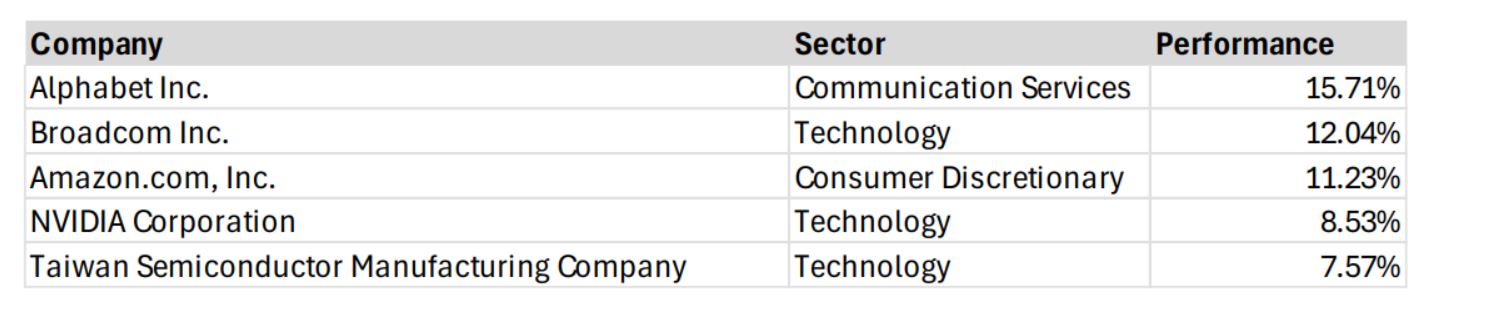
Alphabet Inc.:
- Alphabet Inc’s stock surged in October 2025 due to a record-breaking Q3 earnings report, driven by strong growth in cloud services, advertising, and AI infrastructure.
- Alphabet reported $102.3 billion in Q3 revenue, marking its first-ever quarter above $100 billion. This was a 16% year-over-year increase, beating analyst expectations (source CNBC).
Broadcom Inc.:
- Broadcom Inc’s stock surged 12% in October 2025, driven by a landmark AI chip deal with OpenAI and strong investor confidence in its custom semiconductor strategy.
- OpenAI Partnership: Broadcom signed a massive collaboration agreement with OpenAI to deliver 10 gigawatts of custom AI chips. Analysts estimate the deal could generate up to $200 billion in revenue over time. This positioned Broadcom as a critical supplier in the AI infrastructure race (source Motley Fool).
Bottom Performers
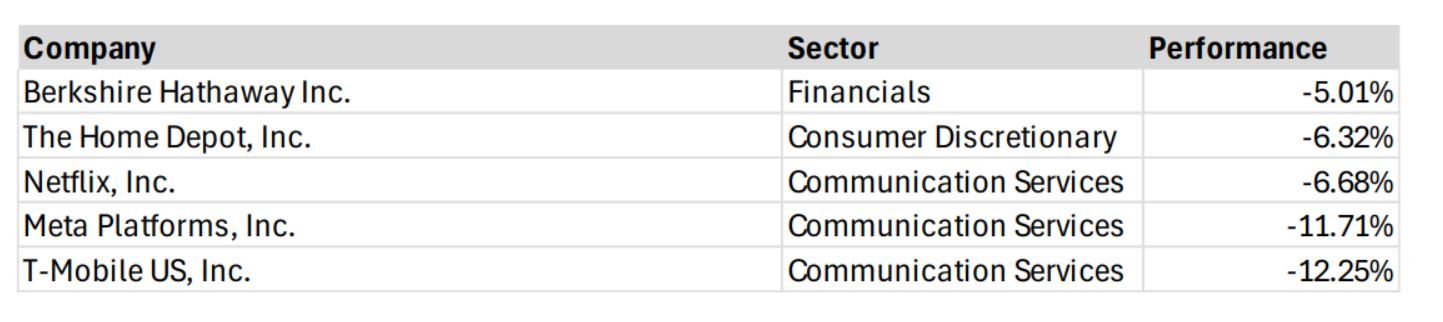
T-Mobile US, Inc:
- T-Mobile US Inc’s stock continued to underperform in October 2025 due to mixed financial results, cautious analyst sentiment, and broader telecom sector headwinds.
- Sector-Wide Pressure: The telecom sector faced headwinds from rising capital expenditures, slower subscriber growth, and increased competition from cable and satellite providers. These macro factors weighed on investor sentiment across the board.
Meta Platforms, Inc:
- Meta Platforms’ stock dropped sharply in October 2025, falling as much as 9% despite strong earnings, due to a surprise $15.93 billion one-time tax charge and increased expense guidance.
- One-Time Tax Charge: Meta took a $15.93 billion non-cash income tax hit linked to the implementation of President Trump’s “One Big Beautiful Bill Act”. This unexpected charge spooked investors, overshadowing otherwise strong financial results (source CNBC).
ETF Portfolio Insights – Vanilla Funds’ Global Balanced GBP Strategy
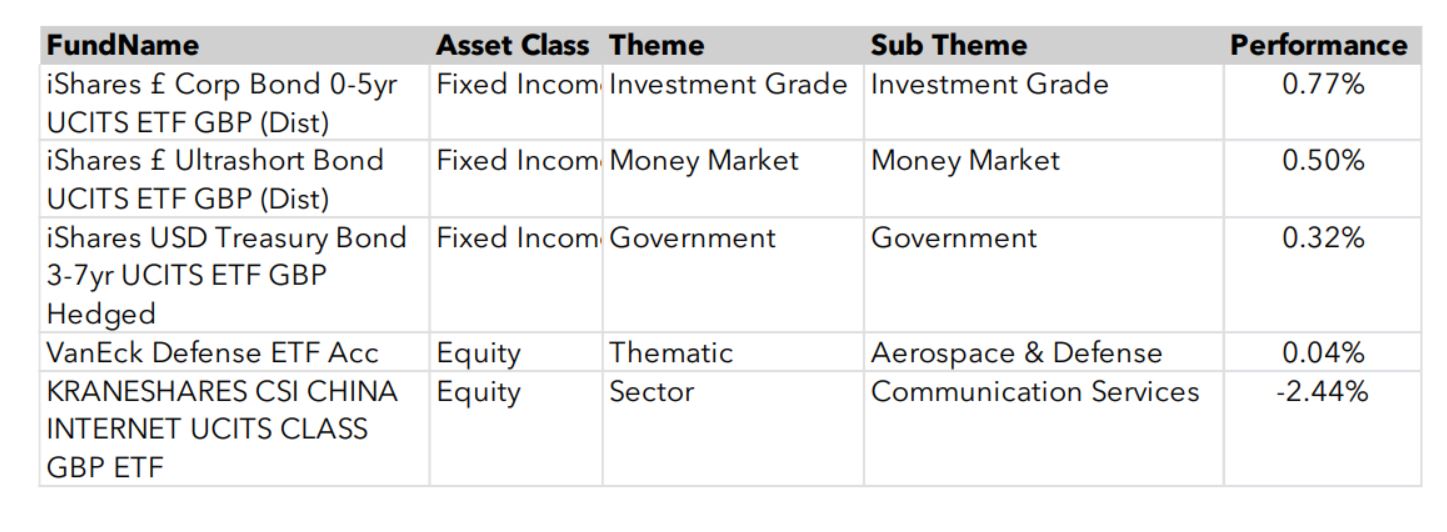
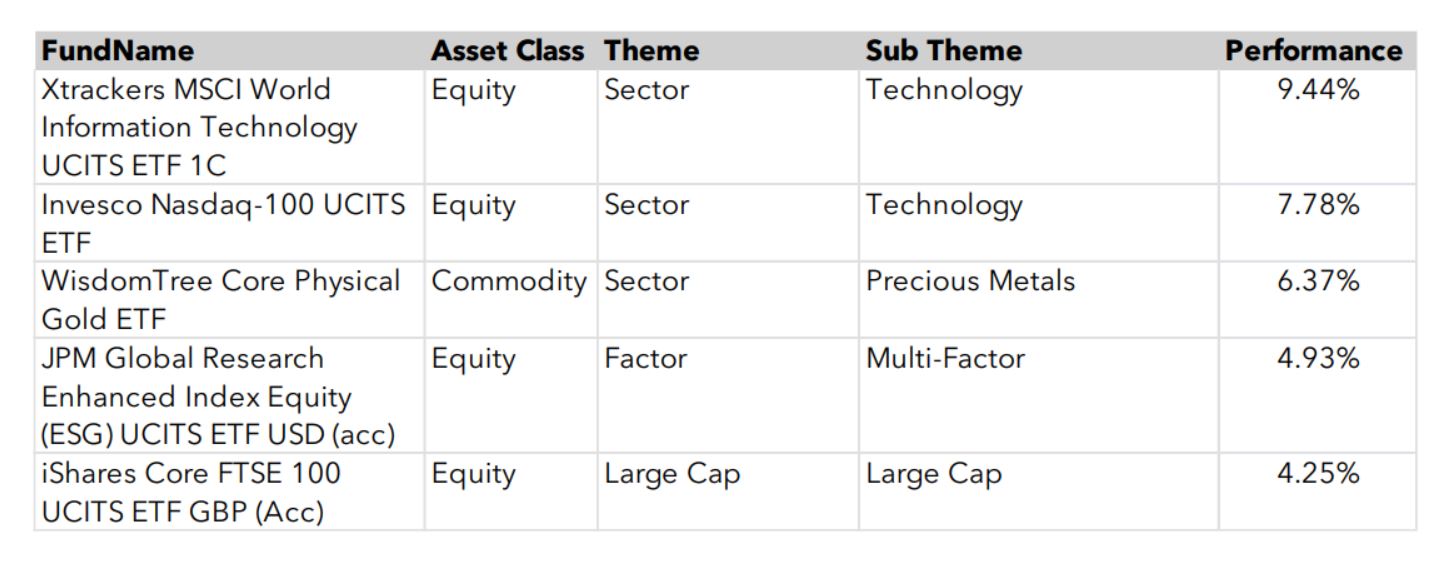
As with the previous month, October proved to be a very good month for multi- asset portfolios. While global tech and AI-linked stocks surged in October, Chinese internet firms lagged due to geopolitical tensions and domestic policy uncertainty. This divergence widened the performance gap between US and China tech ETFs, which resulted in the Kraneshares CSI China ETF delivering a negative return in sharp contrast to the Xtrackers MSCI World Information Technology ETF whose total return performance surged by 9.4%.
Top Performers
Bottom Performers